
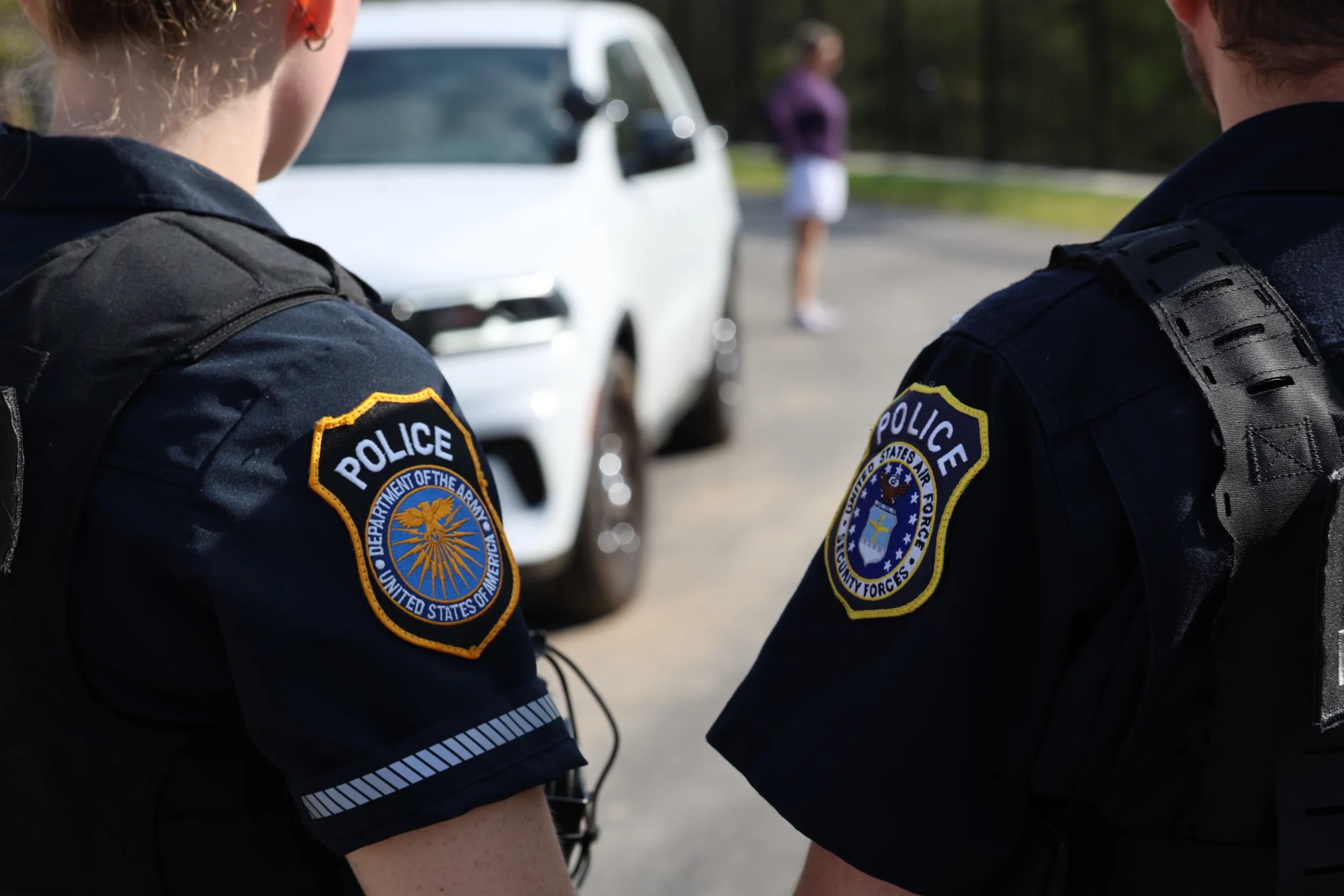
For Officer Theodore McGowan, a last-minute change in training orders became an introduction to joint federal law enforcement.
The Army civilian police officer assigned to Joint Base Myer-Henderson Hall expected to attend training at Fort Leonard Wood, Missouri. Instead, he joined the first Army civilian cohort to attend the VA Law Enforcement Training Center (LETC) Air Force Law Enforcement Academy in Little Rock, Arkansas.
The 10-week academy brings Army civilian police officers together with Air Force military and civilian personnel for classroom instruction and scenario-based training in patrol operations, jurisdiction, use-of-force decision-making and high-risk incident response. Students demonstrate proficiency through written testing, practical exercises and scenario-based evaluations before graduation.
“Just being able to adapt quickly to new things,” McGowan said, describing his principal lesson. “I wasn’t familiar with the Air Force side of things. I’d say that will help me adapt later in my career.”
First Army cohort
The training marks the first time LETC hosted Army personnel in the academy, an important milestone for a program seeking to broaden its role in preparing federal law enforcement officers across the Department of War (DOW).
The Army sent more than a dozen civilian police officers to train alongside 37 Air Force military and civilian personnel, representing more than three dozen installations, putting varied service experience and perspectives to work in the same classroom and scenario-based exercises.
For the Army, the partnership helps address a gap in available training capacity. Wendell “Landon” Morgan, chief of the Air Force Programs Division at VA’s LETC, said the Army is using LETC as an available training option for its civilian law enforcement personnel.
Morgan noted that the partnership could be the beginning of a broader model in which the facility serves as a national training site for law enforcement personnel from DOW service agencies.
“Having Army civilian police officers train here is an important milestone for LETC,” Morgan said. “It demonstrates the value of a joint training environment and helps build a foundation for greater interoperability across federal law enforcement.”
That prospect carries implications beyond the academy itself. Federal officers working on military installations frequently operate within overlapping jurisdictions and may need to coordinate with other military services, local police departments, county agencies, state authorities and federal partners. A common training environment helps officers understand not only the fundamentals of law enforcement but also how counterparts from other agencies and services approach the same mission.
Learning across services
Officer Damien Vera, an Air Force police officer assigned to Schriever Space Force Base in Colorado, said the mix of instructors and students makes the experience more valuable. Vera served nearly five years in the Army and trained as a military police officer before moving into the Air Force environment.
LETC instructors bring backgrounds from the Air Force, Army and Marine Corps.
“There’s different teachings, different ways of doing things,” Vera said. “But it all comes down to the same basis at the end of the day, which is the same type of law enforcement.”
According to Vera, the differences are real, particularly in forms, procedures and administrative processes. But the academy has shown that those differences don’t change the foundations of police work.
“It’s more communication than anything else,” Vera said. “Communication of how each branch does things, so we better understand each other.”
That understanding can have operational value once officers return to installations. The academy’s instruction on jurisdiction and on when to contact outside agencies fills an important need. During his earlier Army training, he learned the jurisdictional boundaries of a base but received less instruction on how and when to engage city, county, state or other federal agencies.
At VA’s academy, the instructors emphasize how jurisdiction shapes decisions about coordination with other law enforcement partners.
“It’s definitely better to learn it here now,” said Vera. “Especially with somebody with no law enforcement background coming here and learning that, it’s definitely a great steppingstone.”
The academy also gives civilian officers who are new to the military environment a chance to learn directly from classmates who understand the culture and operational realities of installations.
Building readiness together
Officer Madison Vinci, an Army civilian police officer assigned to Joint Base Myer-Henderson Hall, came to the academy from civilian policing. Learning alongside Army and Air Force personnel has helped her better understand the military setting where she will work.
“The civilian and military side are two completely different worlds,” Vinci said. “Having the contribution from the Army guys and the Air Force guys—what we can collaborate on or make cohesive—will kind of help along the way with actually learning the military side of things.”
Vinci was struck by the instructors’ depth of knowledge and their experience in the same kinds of jobs facing the students. The academy’s cross-service instruction also has practical relevance for officers assigned to joint installations, including those who may work alongside Air Force units or coordinate with other services in the future.
For her, one of the most lasting benefits has been the relationships formed in class.
“Being in police work, you need to be able to rely on the people next to you,” Vinci said. “You never know, especially being on a military base. It’ll be quiet and then something big will happen.”
Those relationships can endure as officers transfer, seek advancement or meet again at another installation, making future coordination less dependent on unfamiliar names and organizations and more grounded in professional trust.
For McGowan, those relationships matter at a joint installation, where working with other services may become necessary with little warning. Joint Base Myer-Henderson Hall works closely with the Marine Corps, while Andrews Air Force Base is the nearest major Air Force installation. Even if routine coordination is limited knowing what to expect from Air Force counterparts is an asset.
“God forbid we ever need to cross-jam with them,” McGowan said. “Having people go back and know what to expect is, I’d say, a good asset.”
The academy’s practical scenarios reinforce that goal. McGowan had recently completed training in a shoot house, a controlled-scenario training facility where officers practice rapid decision-making in high-risk incidents. He called that preparation invaluable, particularly for officers protecting military installations, personnel and assets connected to national security.
“With the level of assets and people we have on post, in terms of national security and just maybe overall public view, we need to be ready for pretty much anything that might come,” McGowan said.
LETC provides specialized law enforcement training and supports training needs for VA police and other federal partners. VA’s Air Force Law Enforcement Academy received reaccreditation from the Federal Law Enforcement Training Accreditation Board in August 2026, affirming that the program meets established federal standards for law enforcement training.
For the Army civilian officers completing the course, the significance lies in what follows graduation: returning to their installations with a shared operational vocabulary, a clearer understanding of jurisdictional coordination and professional relationships that can support a unified response when an incident demands it.


0 Comments