
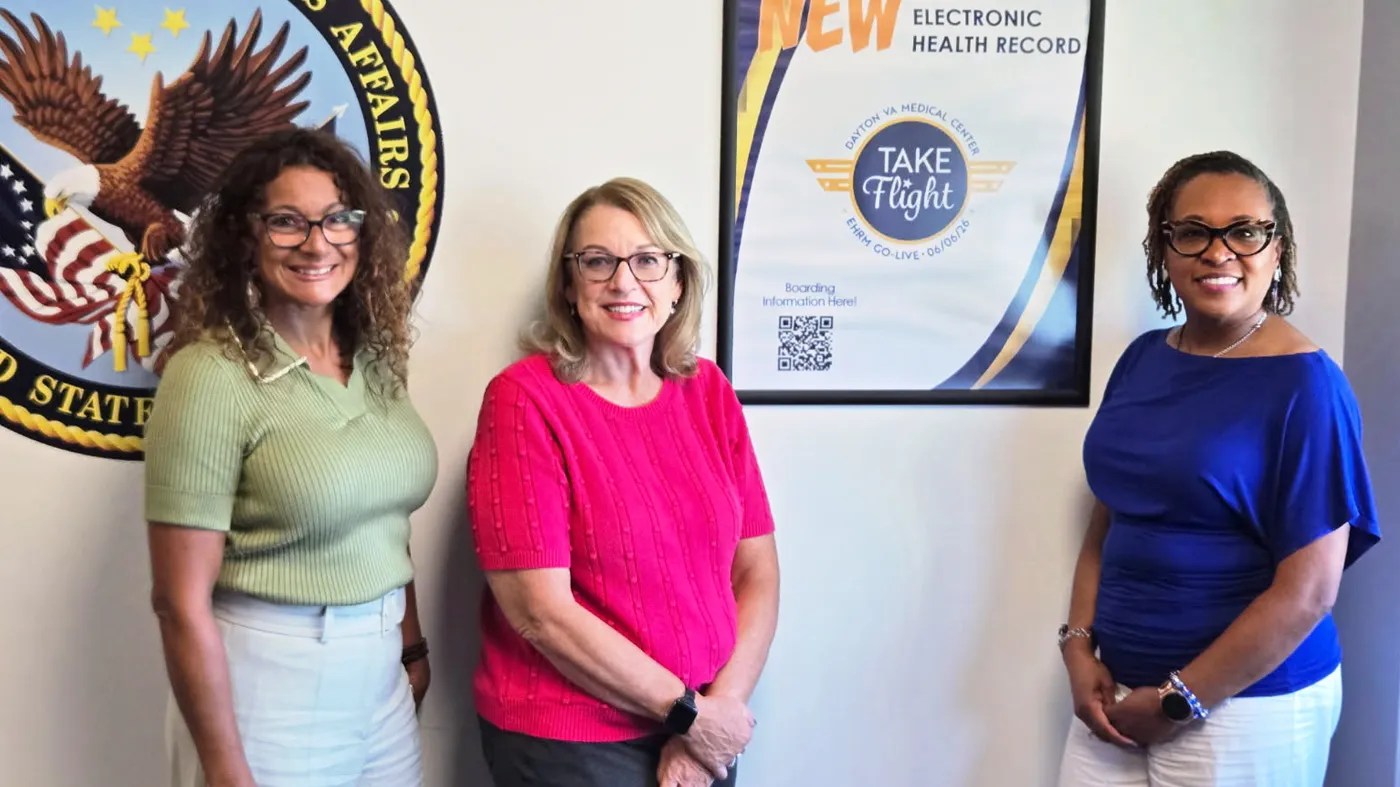
The transition to the Federal Electronic Health Record (EHR) at the Dayton VA Medical Center (VAMC) is more than a technical upgrade, it’s a moment shaped by the people who have dedicated their careers to advancing Veteran care. Among them are three leaders whose combined experience, warmth and unwavering commitment shine through every conversation: Marna McCrary, health promotion/disease prevention program manager; Tronica Wheeler, chief of quality & patient safety; and Linda Borns, nurse manager.
Their insight comes at a pivotal moment as VA accelerates deployment of the Federal EHR, a modern, interoperable medical record system that unites Veterans’ health information across VA, the Department of War and community partners. Unlike the legacy systems that operated facility by facility, the Federal EHR creates nationwide standardization, improves data sharing, and streamlines workflows to enhance safety and continuity of care—all changes these leaders are helping bring to life at the Dayton VAMC.
From paper charts to CPRS: Remembering the early days
The three registered nurses, who have dedicated their entire careers to the Dayton VAMC and together have 94 years of experience, recalled their first experiences with the Computerized Patient Record System (CPRS)—the long-standing system used by VA.
Transitioning from paper to computer-based charting wasn’t simply an upgrade; it transformed the rhythm of clinical work. Wheeler recalled, “Just the mere charting in a computer after years of handwriting—that was huge.” She laughed, remembering the days when staff waited in line for physical charts: “You were fighting to get your chart so you could finish your documentation on time.”
Borns agreed, noting how chaotic paper documentation could be, “…back then, if you dropped a chart, papers went everywhere. You had to reorganize it… and sometimes decipher the providers’ handwriting.” The team still jokes about the color-coded chart folders, the “dial” indicating whether a record needed attention, and the arguments over who got to grab the next available chart. “We welcomed electronic charting,” Borns added. “Really, we were ready.”
McCrary’s memory begins in a computer lab. “I remember a room on the ninth floor with computers everywhere. Someone said, ‘Click here, open this,’ and we learned step by step.” She laughed at how “click happy” she was, eager to explore the new system.
Welcoming change with experience and optimism
At the time, CPRS was easier to adopt; however, the Federal EHR brings a different level of complexity and promise. “We’re going from facility standardization to national standardization,” Wheeler explained. “Workflows now must be consistent everywhere. It’s more structured, and that’s challenging, but it’s also necessary for the future.”
Even so, all three leaders see the benefits. McCrary pointed to providers who say the system allows them to prepare notes more easily and spend more time with Veterans. Wheeler highlighted improvements in medication reconciliation and immunization records, noting that the ability to pull information from outside facilities will streamline care and enhance safety.
Looking ahead with confidence
When asked for advice for other VA sites preparing to go live, the team spoke with clarity. “Be proactive and reach out to counterparts,” McCrary said. “Ask what their workflows look like. Sometimes terminology gets confusing, so learning from others really helps.”
Wheeler emphasized the importance of understanding why processes must change. “Change is hard,” she said. “But it’s for the betterment of our Veterans. We have to slow down, embrace it and trust the process.”
Borns concluded with what mattered most to her: the people. “I’m so proud of our front-line staff,” she said. “They’re supporting each other, taking care of each other, answering each other’s questions. They’re doing it for the right reason: keeping Veterans safe and well cared for.”
Despite the obstacles, all three leaders are optimistic because of their experience and VA’s mission. McCrary shared, “Any challenge thrown at us, we jump in with two feet. At the end of the day, we’re here for the mission of taking care of Veterans… Six months from now, we’ll probably be the ones helping another facility get through it.”
Such is our long and proud legacy of improving care for our nation’s Veterans.


0 Comments